

Guest List Decisions
Set One Plus-One Rule Before You Build Your Guest List.
Plus-one invitations are a headcount decision, not an etiquette debate. Decide your rule early, and it protects your budget, your vendors, and which room actually fits your wedding.
4.9 · 1,400+ Google reviews Three venues, one estate Booking 2027 & 2028
The Real Question
One clear rule beats case-by-case decisions every time.
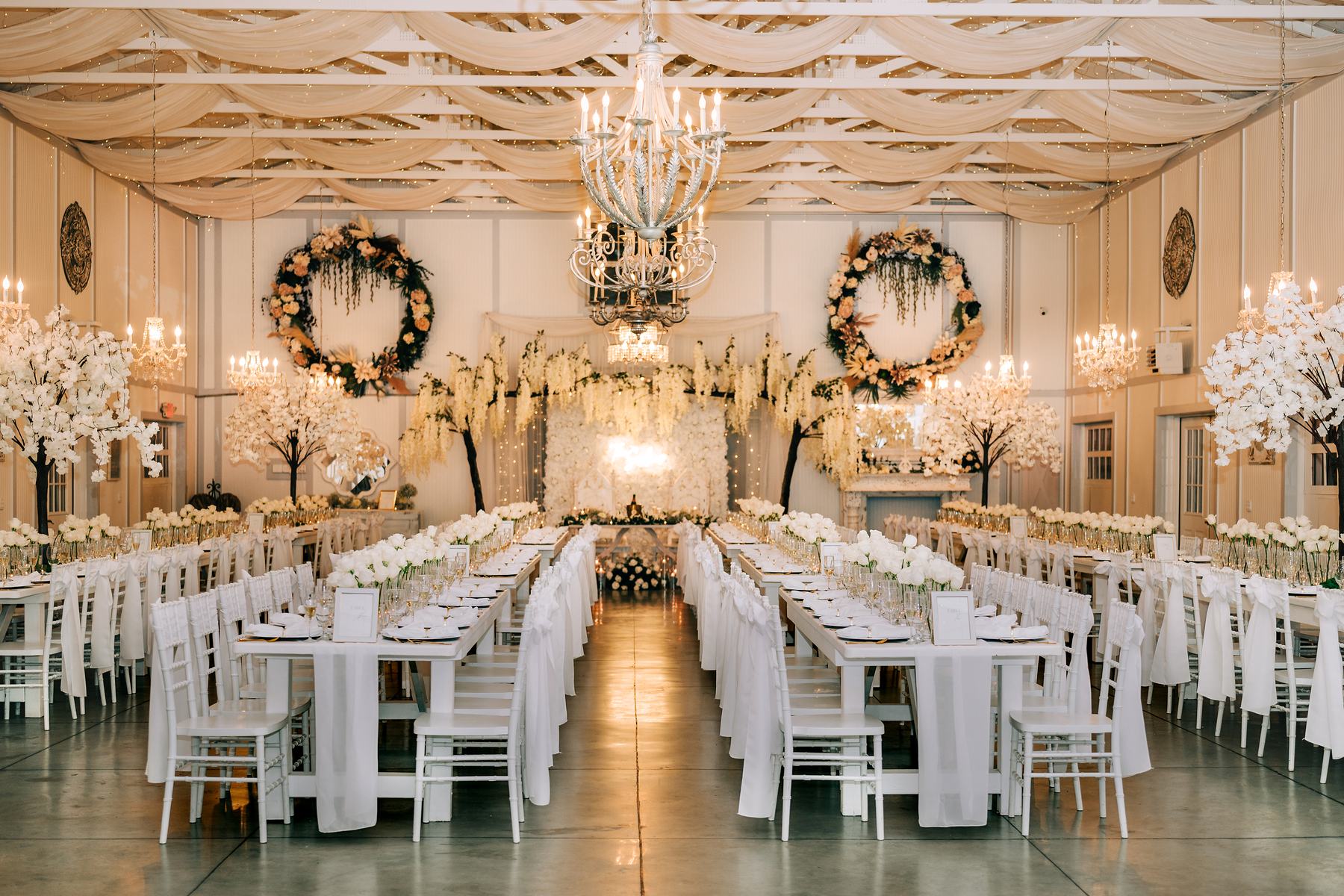
A plus-one invitation is really a decision about your final headcount, and your headcount decides which room you can book. The Barn and the Garden Room each hold up to 150* guests. BoHo holds up to 55. If you invite forty single guests and give all of them a plus-one, you have added forty seats, forty meals, and forty chairs your caterer and rental company need to plan for. That is not a small courtesy. It is a real cost and a real capacity number, and it should be decided at the start of your planning, not three weeks before invitations go out.
*The Barn can accommodate up to 200 guests maximum, and a $50 per person charge will be applied at any party size over 150.
Married couples, engaged couples, and long-term partners living together get invited as a unit. That is not a plus-one, that is inviting a household, and most guests expect it. The gray area is single friends and coworkers you are close to but who are not in a relationship. Some couples give every adult guest a plus-one regardless of relationship status. Others reserve plus-ones for the wedding party and immediate family only. Neither approach is wrong. What matters is that you apply the same rule to every guest on the list, so nobody feels singled out and your final number stays predictable.
Your plus-one policy should get locked in before you request a final headcount from your planner, because that number changes which venue actually fits your wedding. A guest list that looks like 120 names on paper can become 160 once every single guest brings someone, and that number no longer fits BoHo, and it pushes you close to the ceiling on the Barn or the Garden Room. Work through your full guest list strategy on planning for your guests before you tour rooms, and check pricing once you have a real, counted number rather than an estimate you are hoping holds.
Set The Policy
Follow these steps before you write a single invitation.
-
Pick your rule first
Decide once whether every single guest gets a plus-one, only the wedding party does, or nobody outside a committed relationship does. Write the rule down before you build the list.
-
Apply it to everyone
Do not make exceptions for one friend and not another. A rule that changes person to person is the fastest way to create hurt feelings and a guest list that keeps growing.
-
Track two numbers, not one
Keep a running count of invited guests and a separate count of possible plus-ones. That second number is the one that decides whether you are closer to 100 guests or 150.
-
Say it on the invitation, not the guest list
Print the guest’s name and, if they have one, their partner’s name directly on the invitation. Do not write “and guest” and leave the decision open, that is how headcounts drift upward.
Guest Count And Room Fit
Your plus-one math decides which room actually works.
The Barn and the Garden Room both hold up to 150* guests, so a guest list with a generous plus-one policy still has room to work with. BoHo caps at 55, which is a real number worth respecting rather than working around. If your invited list is 45 people and you are offering plus-ones to unmarried guests, you can push past 55 fast, and BoHo simply will not hold that wedding. Deciding your plus-one policy before you choose a room saves you from falling in love with a space that cannot fit the wedding you are actually planning to have.
Couples who want BoHo’s smaller, more intimate scale usually solve this by limiting plus-ones to immediate family and the wedding party, or by capping the guest list itself and being upfront with single friends that the wedding is close family only. That is not a lesser wedding, it is a different one, and BoHo is priced and built for that scale. If your list keeps growing because of plus-ones, that is useful information. It usually means the Barn or the Garden Room fits the wedding you are describing better than the smaller room does. Compare the three rooms directly on pricing before you commit to a guest list you have not finished counting.
Vendors plan around your final number, not your invited number. Your in-house chefs need a plate count, your bar and event staff need a pour count, and your photographer needs a sense of how many people they are covering across the day. A plus-one policy you finalize early gives everyone downstream a number they can actually build a wedding around. One you leave open until the week before invitations go out is the reason final headcounts and budgets shift at the last minute. The whole point of an all-inclusive package, covered on what’s included, is that the big pieces are already handled once your number is real.
Fast Answers
Use these rules when you are stuck on a specific guest.
- Engaged or married guests: invite both names, always.
- Long-term partners living together: treat them as a couple.
- Single friends and coworkers: apply your stated rule, not a case-by-case call.
- Wedding party members: most couples extend a plus-one automatically.
- New relationships under a few months: optional, and reasonable to skip.
Related Reading
Plan the rest of your guest list here.
Also worth reading
The other things guests notice.

Booking 2027 & 2028
Come walk it before you decide anything.
A tour takes about an hour. You’ll see all three venues, the Bridal Suites, and leave with real pricing for your date and guest count — not a brochure.
- No-pressure tour
- Real numbers on the day
- 4.9 · 1,400+ reviews
- Rather just talk 813-909-3414 We answer the phone.
- Quick question Text us Send your date, we’ll reply.
- Coming to see us Get directions 45 min from Tampa.
103 S Saxon Ave., Brooksville, FL 34601 · 45 minutes from Tampa · 90 minutes from Orlando