

Barn weather, honestly
Here's how Florida's seasons actually feel inside a barn, and why that decides your date.
Brooksville barns don’t feel like the outdoors they sit in. Climate control, not the calendar, is what makes any month here work.
4.9 · 1,400+ Google reviews Three venues, one estate Booking 2027 & 2028
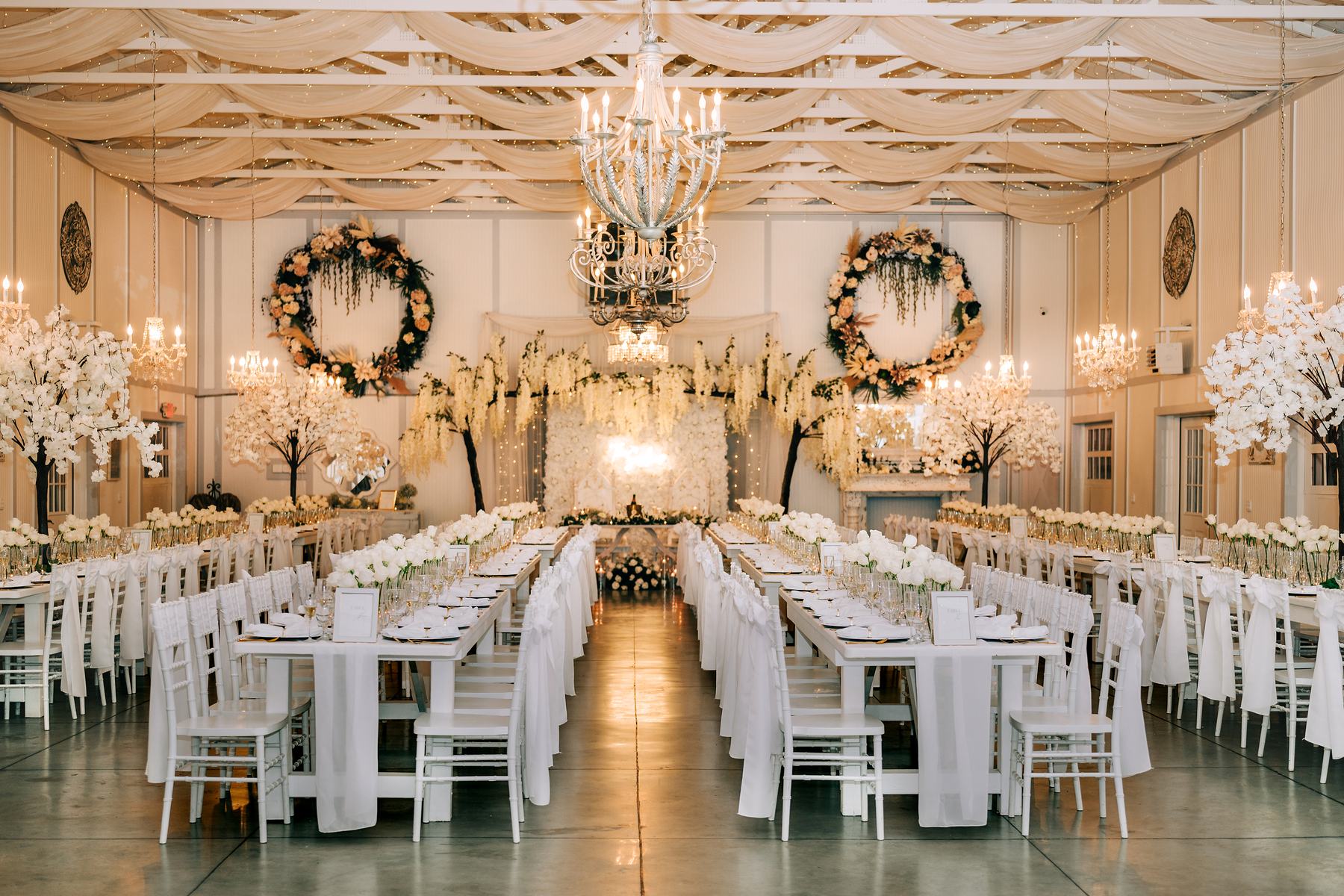
The barn is not the weather
A barn wedding in Florida is a different climate question than a barn wedding anywhere else.
Most articles about wedding seasons assume the barn is a shell that lets outside weather in. That’s true of a barn with open sides and box fans. It is not true of a properly climate-controlled venue, where the building does the work the season would otherwise do for you. In Brooksville, that distinction matters more than almost anywhere in the country, because the gap between a comfortable Florida day and a miserable one can be ten degrees and forty percent humidity. Pick your date around the region’s reputation for seasons and you’re guessing. Pick it around what the room can actually hold steady, and the guesswork goes away.
This is the real question behind every date decision here: not “what’s the weather like in Brooksville in July,” but “what happens to that weather once it’s inside.” A barn with real HVAC turns a 95-degree, soup-thick afternoon into a room where your grandmother in a suit jacket is fine and your guests in cocktail dresses aren’t blotting their makeup by the toast. A barn without it turns even a mild March evening into something that depends entirely on the wind. The building is the variable. The month is just the input.
That’s worth saying plainly because so much wedding content treats season and comfort as the same word. They aren’t. Florida doesn’t have a bad wedding season the way some regions have an actual winter that shuts things down. It has humidity that behaves differently depending on the month, and a barn that either manages that humidity or doesn’t. Once you separate those two things, the calendar stops being a source of anxiety and becomes a much smaller decision: photo light, guest travel, and which weekends are open.
So this page walks through what each stretch of the year actually does to the air inside a barn, what climate control changes about that, and where the real tradeoffs are. None of it is about avoiding Florida. It’s about knowing what you’re buying when a venue says climate-controlled and what you’re risking when a venue doesn’t say that at all.
May through September
Summer is the test every barn has to pass, and most of them fail it quietly.
Summer in Hernando County means heat in the low-to-mid 90s most afternoons and humidity that sits above 70 percent for months at a stretch. That combination is why so much wedding advice tells couples to avoid summer entirely. The advice isn’t wrong for an uncooled barn. A metal or wood-frame structure with no active climate system absorbs that heat all day and holds it, so an evening reception can still feel like 3 p.m. long after the sun is down. Guests sweat through cocktail hour, florals wilt before the first dance, and the photographer is fighting fogged lenses and flushed faces in every frame.
A climate-controlled barn removes almost all of that. The building can hold a stable, dry, comfortable temperature regardless of what the thermometer outside says, which means a June wedding and an October wedding can feel identical to your guests once the doors close. That’s the whole point of building a barn venue with real mechanical systems instead of open sides and ceiling fans: it takes the single biggest risk in a Florida wedding, off the table. You’re not fighting the season. You’re choosing a date based on who can travel, not on whether the room can keep up.
This is also where humidity control matters as much as temperature. A barn can be cool and still feel damp if the air isn’t being dehumidified, and damp air is what wilts a cake’s buttercream, curls hair nobody wants curled, and makes a rented tux feel like a wet blanket by 9 p.m. Ask any barn venue directly whether they control humidity, not just temperature. The answer separates a venue built for Florida from one that’s just a pretty building with an air conditioner bolted on as an afterthought.
None of this means summer weddings here are a compromise. Some of the best light for outdoor portraits happens in the hour before a summer sunset, when the sky does things a February evening can’t. Inside, with the climate handled, that golden hour outside becomes an amenity instead of an ordeal. The season only becomes a liability when the building can’t manage it, which is exactly the gap climate control is built to close.
October through February
Fall and winter are gentler here, and that changes what the barn needs to do, not whether it needs to do it.
By late October, Brooksville’s afternoons settle into the mid-70s and 80s, and the punishing humidity of summer starts to break. This is the stretch most couples picture when they imagine a Florida wedding: doors open, evening air that doesn’t fight you, a barn that can lean on natural airflow instead of working overtime. It’s a real advantage, and it’s why fall and early winter book up fast at nearly every venue in the region. But “gentler” isn’t the same as “no climate control needed.” A warm afternoon can still climb into the mid-80s in early October, and a barn that’s only equipped for mild weather gets caught the same way an uncooled barn gets caught in July, just less often.
Evenings in December and January can also swing the other way, dropping into the 40s and 50s after sunset, which surprises guests who packed for Florida heat and left coats in the car. A barn with working heat, not just air conditioning, handles that swing without anyone noticing. A barn built only to fight heat has nothing to offer on a cold January night, and that’s a detail couples rarely think to ask about until it’s their reception getting chilly at 9 p.m. Climate control in Florida isn’t a one-direction problem. It has to work both ways, even in the mild months.
This is also when the outdoor portion of a wedding does the most work. Ceremony photos in November light, a cocktail hour on a patio that doesn’t need a fan or a heater, a send-off under a sky that isn’t already humid at 6 p.m. The barn’s climate system matters less in these months only because the outside air is doing more of the job for free. That’s the tradeoff worth naming honestly: fall and winter make the building’s systems less necessary, not irrelevant. The demand is on your date’s popularity, not on whether the venue can handle the weather.
That popularity is worth planning around. These months fill first, for good reason, and a venue booking into 2027 and 2028 already reflects that pressure. If the season is doing more of the comfort work for you, use the flexibility that opens up in your budget or your vendor choices elsewhere, rather than assuming the calendar has solved everything for you.
March and April, and the real decision
Spring is the deceptive month, and it’s the clearest argument for asking about climate control directly.
Spring in Brooksville looks easy on paper. Temperatures in the 70s and 80s, humidity that hasn’t yet climbed to its summer peak, azaleas and dogwoods doing their thing outside. It’s a genuinely good stretch for photos and for outdoor ceremony moments. The trap is assuming that because the outside air feels manageable, the barn will too. A structure that’s held heat and humidity all winter can be slower to stabilize on the first true warm week of the year, and an afternoon wedding in late April can catch a barn’s systems off guard the same way a July one does, just with less warning. Spring’s reputation as an easy season is earned outdoors. Indoors, it depends entirely on the building.
This is why the honest answer to “what’s the best season for a barn wedding in Brooksville” isn’t a month. It’s a question you ask the venue: does the barn hold a stable temperature and humidity level regardless of what’s happening outside, in every season, not just the mild ones? A venue that can say yes to that has made the calendar close to irrelevant to your comfort. A venue that can’t has quietly made your wedding date a bet on the weather, whether they say so or not.
The practical version of this: tour in the season closest to your wedding date if you can, and ask specifically how the climate system performs at capacity, with 150 guests, string lights, and a dance floor generating heat of its own. A room that’s comfortable empty on a mild afternoon isn’t the same test as a room that’s comfortable full on a hot one. That’s the gap between a marketing photo and your actual reception, and it’s worth pressing on before you sign anything.
This is the same principle behind the price you’re quoted is the wedding you get. A quote that doesn’t account for real climate control is a quote with a hidden variable in it, one that shows up as a sweating string quartet or a shivering grandmother, not as a line item. Ask the season question, but ask the climate question harder. It’s the one that actually decides how your wedding day feels, no matter which month is on the invitation.
What guests actually say
Reviewers keep landing on the same word: comfortable.
- 4.9 on Google 1,400+ reviews from real couples.
- Family owned Weddings are the only business.
- The Bridal Suites Three furnished rooms to get ready in.
- Florals available Not included. Enchanted Design & Floral, our on-site sister company, books them separately.
- One contract One deposit for the whole package.
- Payment plans Available. Ask on your tour.
Keep planning
Related pages worth a look before you set a date.

Booking 2027 & 2028
Come walk it before you decide anything.
A tour takes about an hour. You’ll see all three venues, the Bridal Suites, and leave with real pricing for your date and guest count — not a brochure.
- No-pressure tour
- Real numbers on the day
- 4.9 · 1,400+ reviews
- Rather just talk 813-909-3414 We answer the phone.
- Quick question Text us Send your date, we’ll reply.
- Coming to see us Get directions 45 min from Tampa.
103 S Saxon Ave., Brooksville, FL 34601 · 45 minutes from Tampa · 90 minutes from Orlando